For SaaS and tech companies with English sites.
:quality(80))
12 Best SaaS SEO Tools, Ranked by Use Case
:quality(80)) Georg Richard Aare
Georg Richard Aare For SaaS and tech companies with English sites.
The best SEO tools for SaaS companies match the job you need done. RankUp covers research, content plans, publish-ready content, applied updates, and measurement, while Semrush and Ahrefs focus on research and SEO data.
However, most SaaS teams end up on the tool treadmill. You pay for Semrush or Ahrefs, pull data out by hand, then still build every outline, keyword cluster, and content update yourself.
The tools show you the problem. They rarely do the work.
This list ranks 12 SaaS SEO tools by what job they actually do, from all-in-one platforms to content optimizers, WordPress plugins, and audit tools. It groups them by use case so you can shortlist by your team's real bottleneck.
One question matters more than any single feature: does the tool only report data, or does it help you turn that data into strategy, content, and updates? Use that question to judge the rankings below.
How to choose a SaaS SEO tool
The right SaaS SEO tool matches your workflow, produces output your team can act on, and measures progress against business outcomes, not just traffic. Five questions narrow the field fast.
1. How much of the workflow should one tool cover?
Professional SEO software commonly starts between $79 and $140 per month. Commonly cited pricing for the standard plans:
SurferSEO around $79/mo
Ahrefs around $129/mo
Semrush around $139.95/mo for the standard Pro plan
That adds up when research, optimization, and reporting live in separate tools. Decide whether you want one system that covers more of the workflow or a lean point tool for a single job.
2. Can your team act on the output without an SEO specialist?
Some tools stop at surface-level traffic metrics instead of the page-level and keyword-level competitor breakdowns you can act on. That gap, seeing the traffic but not the breakdown behind it, is a common complaint about entry-level SEO dashboards.
Early and growth-stage teams should prioritize the tool that solves the current bottleneck, whether that is technical debt or weak content visibility.
3. Research depth and content differentiation
SEO has shifted from keyword-centric reporting toward topical authority and genuine user value. A tool that hands you isolated keywords with no angle leaves the hard part to you.
A useful content brief connects the target keyword, search intent, competitor coverage, a distinct angle, and relevant internal links. Learn how to create an SEO content brief.
4. Does reporting connect SEO work to SaaS outcomes?
Pick a tool based on your current budget and growth stage, then upgrade as reporting and research needs get more advanced.
The reporting should tie back to your real conversion events: demo and sales-call requests, plus trial or freemium signups. If a tool only measures traffic, it can't tell you whether SEO is feeding pipeline.
5. Do you need Google-only SEO or Google plus AI visibility?
Buyers now research SaaS across Google, ChatGPT, Claude, Perplexity, and Google AI Overviews. Evaluate whether a tool helps you monitor discovery beyond classic SERPs, and decide how that stack should work before you buy.
Criterion | What to check | Common trap |
|---|---|---|
Workflow coverage | How much of research, optimization, audits, and reporting the tool handles | Paying for multiple point solutions that create manual handoffs |
Actionable output | Whether your team can turn data into decisions quickly | Buying specialist-grade dashboards your team cannot interpret |
Research depth | Support for topic clusters, intent, competitor gaps, and unique angles | Targeting isolated keywords with no differentiation |
SaaS reporting fit | Ability to measure progress against your conversion goal | Treating traffic alone as success |
AI visibility readiness | Whether the tool helps you monitor discovery beyond classic SERPs | Assuming Google rankings capture the full search journey |
The 12 best SaaS SEO tools, ranked by use case
This list ranks 12 SaaS SEO tools by primary use case, workflow coverage, and starting cost where a price is available.
RankUp comes first because it combines research and prioritization with publish-ready content, applied updates, and reporting in one workflow.
The other 11 tools are grouped into five use-case categories: all-in-one platforms, research and competitive intelligence, content optimization, WordPress plugins, and audit and reporting. Each entry explains what the tool covers and where its workflow stops, so you can shortlist by your bottleneck.
Choose by job | Tool and mechanism | Work your team still owns |
|---|---|---|
Get content written and improved | RankUp turns product expertise into publish-ready articles and written content updates | Supply product expertise and review the finished work |
Investigate competitors and backlinks | Ahrefs provides backlink and competitor analysis through Site Explorer | Turn the findings into content and site changes |
Equip an existing writing team | Frase combines SERP research, briefs, and content scoring | Edit drafts and handle site-wide auditing separately |
1. RankUp
RankUp is an SEO and GEO content system for SaaS founders and lean marketing teams who want finished content, not briefs for their team to write from. It turns product expertise into publish-ready articles and keeps published content improving, helping buyers find and evaluate your product through Google and AI discovery.
RankUp combines research, prioritized content plans, publish-ready content, applied updates, and reporting in one system:
It carries work through to completion. RankUp researches topics, prioritizes content plans, writes publish-ready articles, and prepares written updates for review.
It writes from your expertise. Every draft is built from your knowledge base, style guide, and a reference article you pick, then self-reviewed against all three before you see it.
Creation and updates live in one system. RankUp can prepare new and updated content as visible, reviewable changes, so the work does not disappear into a separate backlog.
It compounds. Every run adds your answers to the knowledge base, so the next article starts with more context than the last.
How RankUp does the work
Magnus researches keywords and prioritizes topics, Cedric creates publish-ready content, and Lyra manages applied updates and reporting after you publish.
For a content update, review the written change and approve, then RankUp applies it to your CMS.
Customer outcome
RankUp customer Bilt.me achieved 17x growth in monthly visits from AI search within three months of launching its SEO efforts.
If you want a content workflow that starts with your brand context and carries it into research, drafting, and updates, start your 7-day free trial. The trial is only available to SaaS and technology companies with English-language websites.
Keyword research and planning
Keyword research is where most SEO work stalls. Magnus runs that whole phase for you, so planning starts from organized topic clusters, not a blank spreadsheet.
Magnus runs the research phase end to end
Magnus identifies competitors, discovers keywords, clusters them into topical groups, and builds a prioritized content plan.
Priority scores help you decide which topic to work on next without sorting a spreadsheet by hand.
Magnus can also evaluate and select the best keyword cluster for a plan, so you skip reviewing every label and keyword by hand.
Planning speed goes from days to minutes
Keyword research can move from days of manual work to minutes. Elena Daskalova, Senior SEO/GEO Consultant at Opullex, described accessing thousands of relevant keywords, exploring parent topics, and creating clusters in a matter of minutes.
The plan maps topics to intent and buyer discovery
A content plan can cover educational, navigational, and transactional intent so you can create pages for buyers learning about a category and buyers comparing vendors.
Transactional competitor terms, including alternatives and comparison searches, can help you cover late-stage evaluation questions alongside broader educational topics.
Content creation workflow
Cedric owns the content creation flow, taking a topic from research-backed outline to blueprint to publish-ready draft in one run.
Outline and blueprint come before drafting
The content flow starts with a target keyword. It pulls live Google results, fetches ranking competitor pages, extracts their outlines, and researches your knowledge base for context.
From there it proposes an outline shaped around SERP gaps: a business-specific H1, FAQ ideas from People Also Ask and missed competitor subtopics, plus brand-informed conclusion and CTA direction.
That outline becomes a per-section blueprint with competitor answers, differentiation notes, and talking points for each section.
Interview prompts appear only where context is missing
Before drafting, RankUp asks focused questions only where the blueprint has a real knowledge gap. Each comes with a suggested answer you can accept or override.
Because it reads your knowledge base first, it skips generic questions and asks only what would materially improve the article.
Cedric drafts, self-reviews, and prepares internal links
Cedric writes section by section with your creative brief, style guide, knowledge base, and existing content loaded into context.
The finished draft is self-reviewed against RankUp's writing rules, a quality checklist, the style guide, the brief, and your chosen reference article before fixes get applied.
After cleanup, RankUp analyzes the draft against your existing pages and presents internal link proposals for approval.
You choose how hands-on to be
You set how much you touch. Let it run start to finish, have it stop when it hits a real judgment call, drop in your own checkpoints, or steer every step yourself.
Here is the keyword-to-draft flow in action:
Content updates and reporting
Lyra identifies pages that need work, frames the update task, routes writing changes to Cedric, and generates monthly reports that explain performance changes and next actions.
Lyra runs the update and audit workflow
Lyra keeps your published pages working after you hit publish: content updates, audit fixes, internal linking, site-wide changes, and brief and knowledge base edits.
The automated audit analyzes existing pages, flags underperforming content, explains why each page needs work, and gives specific improvement recommendations.
Audit findings become reviewable content changes
Lyra decides what needs to change on each page and routes the writing work to Cedric.
For quick wins, you bulk implement many improvements at once. For deeper pages, Lyra runs the analysis, frames the task, and Cedric writes the actual changes for your review.
You pick the improvement type, then the system executes the change instead of handing you a to-do list.
Reports explain what changed, why, and what to do next
Monthly performance reports generate automatically. Each one identifies specific changes in performance, explains the causes, and includes next-step recommendations.
The page-level view marks whether a page improved, declined, or held steady, and explains the reason behind each outcome.
Here is how Lyra finds pages, decides what to change, and routes the work to Cedric:
The update loop is built for speed after publishing
Content audits move from manual multi-tool analysis to automated workflows with ready-to-apply recommendations. Monthly reports go from manual assembly to zero-effort generation.
That means existing pages keep working instead of decaying while you focus elsewhere.
Why the knowledge base matters
The knowledge base is the layer that makes RankUp sharper over time, storing your brand voice, positioning, and every new answer so future work starts with more context than the last run.
Shared memory across Magnus, Cedric, and Lyra
The knowledge base lives inside RankUp and holds your creative briefs and style guides, teaching the agents your brand voice and positioning.
RankUp reads it during the content flow before deciding which questions still need your input.
Each run adds context for the next
The content flow asks focused questions where knowledge is missing, then feeds your answers back into the system.
Every new article adds context that helps later articles start sharper. That same growing base gives Lyra better context for updating content already live on your site.
Who RankUp is for
RankUp fits SaaS founders and GTM, sales, and marketing leaders who want their product to show up when buyers research their category on Google and AI tools. It handles the strategy, content, and improvement work that turns that goal into a repeatable process.
SaaS GTM, marketing, sales, and founder-led teams
The core audience is SaaS founders and GTM, sales, marketing, and lean growth leaders who want qualified buyers to find their product through Google and AI answers. They need a clear path to stronger rankings and more relevant AI visibility without becoming SEO or GEO specialists.
It is built for SaaS specifically, not e-commerce shops, SEO agencies, or freelance consultants.
Common triggers: plateaued growth and manual overload
Teams evaluate RankUp when competitors appear in the AI answers their buyers read, leadership asks for an AI-search plan, or they need search to support distribution and qualified demand. Some arrive with underperforming content, while others are starting from scratch.
It also fits teams paying for several SEO tools while still doing the strategy, writing, and optimization by hand.
When one person needs the output of a content team
RankUp brings strategy, research, writing, updates, and reporting into one coordinated workflow. Your team triggers the work, adds product expertise when a real gap appears, and reviews the finished changes before publishing.
That suits teams who publish inconsistently, guess at what is working, and feel the gap between needing SEO content and actually producing it.
When RankUp is less of a fit
RankUp is a system, not a raw data suite. A few situations point elsewhere:
You have SEO specialists who mainly want reporting depth. RankUp fits teams buying completed content work, with performance reports guiding what to improve next.
You only need content scoring on drafts you already write. RankUp fits teams that want the writing and updates done for them, with finished work to review.
You want zero involvement. RankUp still expects human review, a CMS for publishing, GSC for performance data, and your input when it finds a real knowledge gap.
If you want a system that handles strategy, content creation, and updates in one workflow, start your 7-day free trial.
That covers RankUp, our own category of one. Here are the other 11 tools, grouped by the main job each one does.
All-in-one SEO platforms
All-in-one SEO platforms group keyword research, backlink analysis, audits, and rank tracking in one system. The tools below differ mostly in data depth, workflow breadth, and price.
Tool | Category role |
|---|---|
Semrush | All-in-one SEO suite |
Ahrefs | All-in-one SEO suite |
Moz Pro | All-in-one SEO suite |
SE Ranking | All-in-one SEO suite |
2. Semrush
Semrush is an all-in-one SEO suite for keyword research, competitor analysis, site audits, rank tracking, and reporting.
What work does Semrush centralize?
Semrush manages competitor analysis, keyword research, site health, and rank tracking in one platform.
All-in-one suites like this form the base of a stack when a team needs keyword research, rank tracking, backlink analysis, and site audits together.
What does Semrush cost to start?
Semrush's standard SEO Toolkit starts at $139.95 per month for Pro, or $117.33 per month billed annually. Guru runs $249.95 per month ($208.33 annually), and Business is $499.95 per month ($416.66 annually).
Semrush One, which bundles the SEO and AI toolkits, sits higher: $199 per month for Starter, $299 for Pro+, and $549 for Advanced.
Plan | Monthly | Annual monthly equivalent |
|---|---|---|
SEO Toolkit - Pro | $139.95 | $117.33 |
SEO Toolkit - Guru | $249.95 | $208.33 |
SEO Toolkit - Business | $499.95 | $416.66 |
Semrush One - Starter | $199 | $165.17 |
Semrush One - Pro+ | $299 | $248.17 |
Semrush One - Advanced | $549 | $455.67 |
3. Ahrefs

Ahrefs is an all-in-one SEO platform for backlink analysis, keyword research, site audits, rank tracking, and content research.
Which core tools are inside Ahrefs?
Ahrefs includes Site Explorer, Keywords Explorer, Site Audit, Rank Tracker, and Content Explorer.
Together they cover backlink analysis, keyword research, technical audits, and rank tracking in one interface.
How broad is Ahrefs compared with point tools?
Ahrefs sits alongside Semrush and Moz as a platform that supports a full range of SEO tasks in one place, covering technical, off-page, and on-page work.
Ahrefs core tools | Main use |
|---|---|
Site Explorer | Backlink and competitor analysis |
Keywords Explorer | Keyword research |
Site Audit | Technical audits |
Rank Tracker | Ranking monitoring |
Content Explorer | Content research |
4. Moz Pro

Moz Pro is an all-in-one SEO suite for keyword research, backlink analysis, site audits, and rank tracking.
What makes Moz Pro an all-in-one suite?
Moz Pro covers keyword research, backlink analysis, competitor analysis, site health, and rank tracking in one platform.
Where does Moz Pro fit in this list?
Moz Pro groups with Semrush and Ahrefs as a platform for handling a full suite of SEO tasks in one place. It fits teams that want research and ongoing SEO management under one subscription.
5. SE Ranking
SE Ranking is an all-in-one SEO platform for keyword research, site audits, rank tracking, and competitor monitoring.
Why is SE Ranking in the all-in-one group?
SE Ranking combines keyword research, audits, rank tracking, and competitor monitoring in one system, which places it with the all-in-one platforms rather than research-only or optimization-only tools.
What should SaaS teams compare it on?
SE Ranking competes with Semrush, Ahrefs, and Moz Pro on three axes: workflow breadth, data depth, and starting cost.
For early-stage SaaS teams, a lower starting cost usually matters more than the deepest dataset. Once decisions hinge on backlink or keyword accuracy at scale, data depth starts to outweigh price.
Research and competitive intelligence tools
Research and competitive intelligence tools are SaaS SEO products focused on competitor keywords, backlinks, traffic patterns, and market gaps. The next two tools show the difference between a lighter research toolkit and a deeper competitor-intelligence workflow.
Tool | Primary intelligence angle | Typical SaaS use |
|---|---|---|
Mangools | Lighter keyword and SERP research | Early-stage keyword validation |
SpyFu | Competitor keyword and PPC intelligence | Competitor tracking and market research |
6. Mangools
Mangools is a lightweight SEO toolkit for keyword research, SERP analysis, backlink checks, and rank tracking.
How deep is Mangools for competitor intelligence?
Mangools handles keyword research, SERP analysis, backlink checks, and rank tracking as a lightweight toolkit.
For deep competitor intelligence, target keywords, backlink profiles, and traffic breakdowns, teams more often reach for Ahrefs, Semrush, or SpyFu. Mangools sits at the lighter end of that research spectrum.
Toolkit research versus automated research
With a toolkit like Mangools, you run competitor lookups, then brainstorm, filter, and group keywords into topics by hand.
Automated research works differently. It identifies competitors from business relevance and search performance, discovers keywords from competitor and SERP data, then clusters related terms into topic groups with primary and secondary keywords.
That means you are not manually deduping keywords across five spreadsheets, or finding two articles targeting the same term after both go live.
Dimension | Mangools |
|---|---|
Primary role | Lightweight SEO research toolkit |
Depth for competitor intelligence | Lighter than Ahrefs, Semrush, or SpyFu |
Keyword workflow | Manual lookups, then group topics by hand |
7. SpyFu
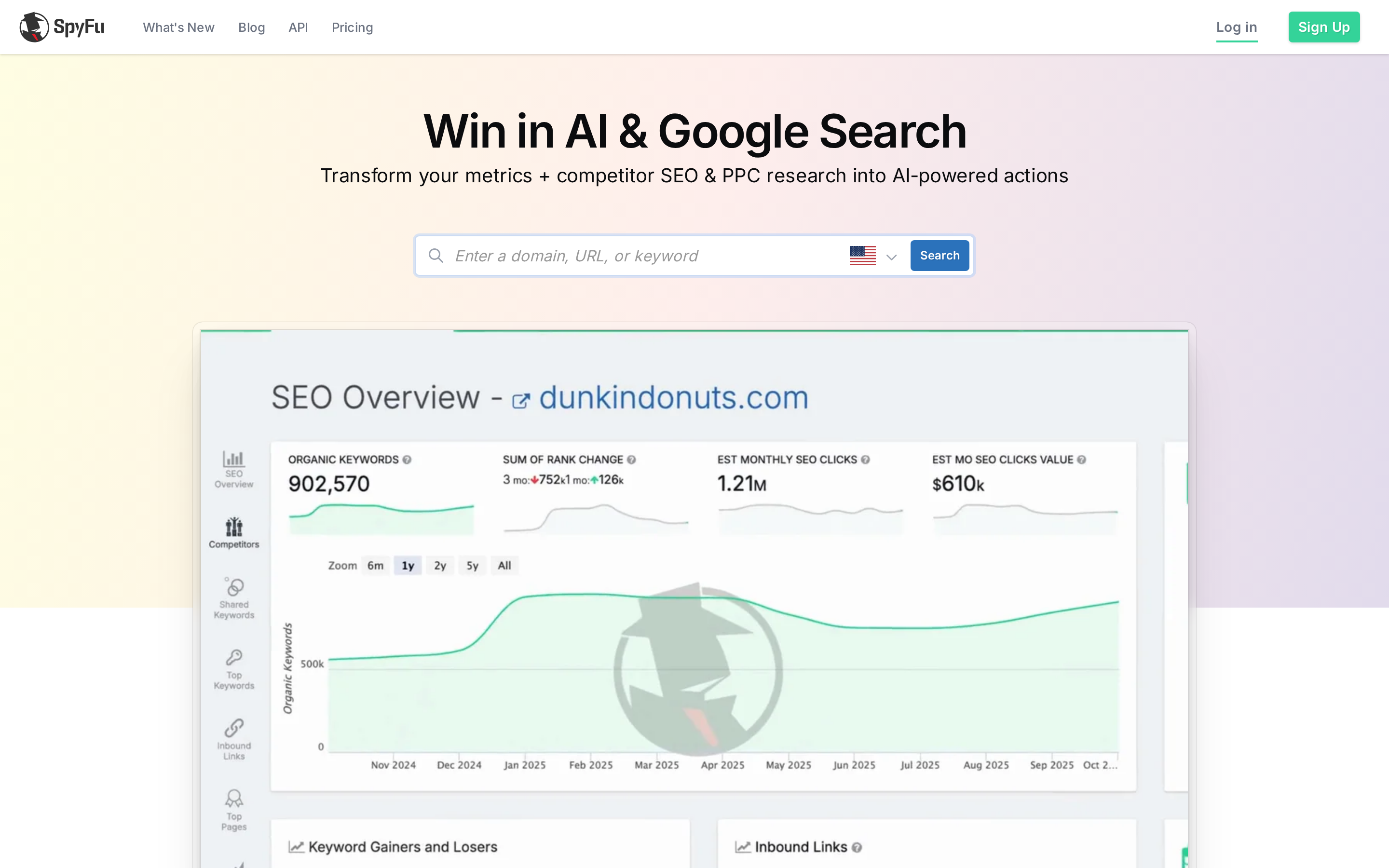
SpyFu is a competitor intelligence tool for SEO and PPC keyword research, backlink analysis, and traffic-source investigation.
What intelligence is SpyFu known for?
SpyFu focuses on competitor intelligence across four areas:
Target keywords competitors rank for
Backlink profiles and keyword strategies
Traffic sources and keyword history
Paid search strategy alongside organic keywords
It is used to examine competitor keywords, paid-search history, and backlink data.
From competitor intelligence to a content plan
SpyFu surfaces competitor keyword, backlink, and paid-search data.
The next step, turning that intelligence into a plan, usually happens elsewhere. Automated planning discovers keywords from competitor and SERP data, clusters them into topics, then adds priority scoring and coverage status so the next topic comes from the cluster map instead of ad hoc judgment.
Dimension | SpyFu |
|---|---|
Primary role | Competitor intelligence for SEO and PPC |
Core capabilities | Competitor keywords, backlinks, traffic, paid search |
Workflow after insights | Research-focused; planning happens elsewhere |
Content optimization tools
Content optimization tools focus on making individual pages stronger through briefs, topical coverage, and on-page guidance. In this list, Frase and Rankability sit in that narrower layer of the SaaS SEO workflow.
Tool | Optimization focus | Typical SaaS use |
|---|---|---|
Frase | Page-level research, briefs, and content scoring | Building briefs and optimizing drafts to match intent |
Rankability | Content scoring and optimization workflow | Improving individual pages against ranking pages |
8. Frase
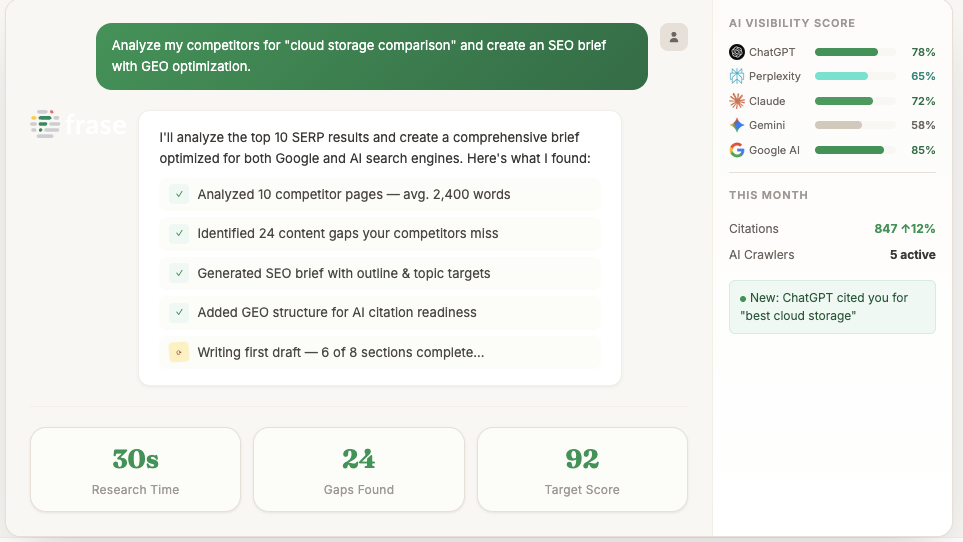
Frase is a content optimization tool focused on page-level research, briefing, and refinement rather than running the full SEO stack.
The category covers the writing-and-scoring layer of SEO:
Outline and brief generation from top-ranking pages
Keyword and topic coverage analysis
Semantic, NLP-based content scoring
Real-time on-page feedback for matching search intent
Frase sits in that layer. Its job is writing, scoring, and optimizing individual pages, not crawling, backlink analysis, or reporting.
9. Rankability
Rankability is another content optimization tool, centered on improving individual pages instead of running the full SEO stack.
Like Frase, it reduces the manual work of matching content to search-engine NLP: topic coverage, word-choice alignment, heading structure, and keyword usage. Its role is page improvement, not backlink analysis, crawling, or reporting.
WordPress SEO plugins
WordPress SEO plugins are CMS-native tools for handling metadata, sitemaps, schema, and other foundational SEO tasks inside WordPress. The two options below cover similar basics but differ in workflow emphasis and technical controls.
Tool | Primary WordPress SEO role | Notable built-in areas |
|---|---|---|
Yoast SEO | Foundational on-page and technical SEO | Meta tags, XML sitemaps, schema |
All in One SEO | Foundational on-page and technical SEO | Meta tags, XML sitemaps, robots.txt, redirects |
10. Yoast SEO
Yoast SEO is a WordPress plugin for managing foundational on-page and technical SEO elements like metadata, sitemaps, and schema.
What SEO work does Yoast handle in WordPress?
Yoast SEO manages foundational on-page and technical SEO inside the WordPress dashboard:
Automates meta titles and meta descriptions
Generates XML sitemaps for indexing
Implements schema markup without manual code edits
It keeps metadata and basic on-page SEO in check, but it is plugin-level management, not a full SEO stack.
Dimension | Yoast SEO |
|---|---|
CMS fit | WordPress |
Main scope | Foundational on-page and technical SEO |
Named capabilities | Meta titles, meta descriptions, XML sitemaps, schema |
Workflow limit | Plugin-level SEO management, not full SEO stack |
11. All in One SEO
All in One SEO is a WordPress plugin for managing foundational technical SEO controls like metadata, sitemaps, schema, robots directives, and redirects.
Which technical controls does All in One SEO add?
All in One SEO (AIOSEO) manages on-page and technical SEO controls in WordPress:
Meta titles and meta descriptions
XML sitemaps for crawling and indexing
robots.txt configuration and URL redirect management
All in One SEO handles on-page and technical SEO controls at the plugin level, alongside a full plugin-based SEO setup.
Dimension | All in One SEO |
|---|---|
CMS fit | WordPress |
Main scope | Foundational technical and on-page SEO |
Named capabilities | Meta tags, XML sitemaps, schema, robots.txt, redirects |
Workflow limit | Plugin-level SEO management, not research or competitive intelligence |
Audit and reporting tools
Audit and reporting tools are SaaS SEO products focused on finding site issues, tracking performance, and turning SEO data into recurring reports.
12. SEOptimer

SEOptimer is a SaaS SEO audit and reporting tool for site audits, keyword tracking, backlink research, and white-label client reporting. It starts at $29 per month, or $21.75 per month billed annually, on the DIY SEO plan.
What does SEOptimer do?
SEOptimer runs instant site audits that score a site across on-page SEO, usability, performance, and social signals, then turns each check into prioritized fixes.
It pairs those audits with keyword tracking, backlink research, and an embeddable white-label audit tool, which is why agencies and freelancers use it for recurring client reports.
What does an SEOptimer audit check?
An SEOptimer audit scores a site across five areas: on-page SEO, usability, performance, social presence, and backlinks. Each area comes with prioritized, plain-language recommendations.
It also crawls the whole domain for broken links, indexing issues, and duplicate content, then schedules those findings into recurring reports.
Dimension | SEOptimer |
|---|---|
Main scope | Site audits, keyword tracking, backlink research, reporting |
Standout feature | Embeddable white-label audit tool for lead generation |
Best fit | Agencies and freelancers running client-facing reports |
Starting cost | $29/month ($21.75/mo billed annually) on DIY SEO |
Comparison table: use case, workflow coverage, and starting cost
This table compares the 12 SaaS SEO tools by primary use case, workflow coverage, and starting cost, highlighting the tradeoff between lower-cost point tools, WordPress plugins, and broader all-in-one platforms that centralize more of the SEO workflow.
How the 12 tools compare on category, breadth, and entry cost
The list spans five categories: all-in-one platforms, research and competitive intelligence, content optimization, WordPress plugins, and audit and reporting.
Ahrefs bundles Site Explorer, Keywords Explorer, Site Audit, Rank Tracker, and Content Explorer in one product, covering a wide range of SEO tasks.
Semrush starts around $139.95 per month for its standard Pro plan, a higher entry point than the lighter tools and plugins. Point tools can start around $29 to $139 per month, but stacking several of them can approach or exceed the cost of one broader platform.
Tool | Primary SaaS SEO use case | Workflow coverage | Starting cost |
|---|---|---|---|
RankUp | Agentic SEO & GEO content team | Keyword research, clustering, article creation, audits, reporting | 7-day free trial |
Semrush | All-in-one SEO platform | Research, site audits, rank tracking, reporting, broader SEO suite | $139.95/month ($117.33/mo annually) for Pro |
Ahrefs | All-in-one SEO platform | Backlink analysis, keyword research, site audits, rank tracking, content research | $129/month |
Moz Pro | All-in-one SEO platform | Research and ongoing SEO management | $49/month ($39/mo annually) for Starter |
SE Ranking | All-in-one SEO platform | Research, tracking, audits, and reporting | $129/month ($103.20/mo annually) for Core |
Mangools | Research and competitive intelligence | Keyword research and SERP analysis | $29/month ($23.20/mo annually) for Entry |
SpyFu | Research and competitive intelligence | Competitor keyword research and PPC/SEO intelligence | $39/month ($29/mo annually) for Basic |
Frase | Content optimization tool | Content research, briefs, writing, optimization | $49/month ($39/mo annually) for Starter |
Rankability | Content optimization tool | Content scoring and optimization workflow | $199/month for Core |
Yoast SEO | WordPress SEO plugin | On-page optimization inside WordPress | Free plan; Premium from $118.80/year (about $9.90/mo) |
All in One SEO | WordPress SEO plugin | On-page optimization and site settings inside WordPress | Free plan; Premium from $49.50/year first year, renews $99/year |
SEOptimer | Audit and reporting tool | Site audits, keyword research, rank tracking | $29/month ($21.75/mo annually) for DIY SEO |
The SaaS SEO system that does the work: RankUp
SaaS founders and GTM, sales, and marketing leaders often need more than a dashboard. They need qualified buyers to find their product when category, alternative, comparison, and vendor searches happen across Google and AI tools.
RankUp turns research into a content plan, publish-ready drafts, updates, and performance decisions. That work gives your product a stronger foundation to earn rankings and AI mentions or citations over time.
RankUp carries your documented brand voice, positioning, and product knowledge from one workflow into the next through its knowledge base.
Research, content creation, updates, and reporting come together in one RankUp workflow, with each step informed by the context your team has already documented.
For lean SaaS teams, that matters where it counts: one person can oversee research, finished content, applied updates, and reporting in one workflow.
Guardian Home co-founder Alonso on filling their pipeline with RankUp content
And the system compounds. Your knowledge base grows with every run, so future articles start sharper and Lyra gets better at improving the pages you already have live.
If you want to replace manual handoffs with a workflow that carries your brand context from planning through updates, start with an article your team can review and refine.
RankUp researches topics, prioritizes content plans, and prepares content changes for review across Google and AI-search content work. Start your 7-day free trial to see the workflow with your site’s brand voice, knowledge base, and content plan.
Frequently asked questions
How are SaaS SEO tools different from general SEO tools?
SaaS SEO tools are used to research, create, optimize, and measure content for a software buyer’s search journey. They often support comparison and evaluation topics, such as alternatives and best-[category] searches, alongside informational content.
For SaaS, the useful outcome is a clearer connection between search work and conversion events such as demo requests, sales calls, trials, or freemium signups.
Should SaaS teams hire an agency instead of buying tools?
Hire an agency when your main gap is strategy and execution capacity. Buy tools when your team knows what to do but needs better data, coverage, or lower-cost execution.
If your gap is execution, RankUp can turn planning, drafting, and content updates into reviewable work in one system. Start your 7-day free trial to test that workflow on your site.
Can SEO SaaS tools replace an in-house SEO team?
Agentic SEO systems can handle research, outlining, drafting, review, and cleanup in one workflow, so one person can cover more of the content cycle.
Human judgment still matters for product positioning, proprietary expertise, and final approval before publishing.
Which SaaS SEO tools are best for resolving technical website issues?
For deep technical audits, Screaming Frog and Sitebulb are the dedicated crawlers, with Sitebulb adding visual reporting.
Semrush, Ahrefs, and Moz Pro include site-audit crawlers that flag broken links, crawl errors, and slow pages, while SEOptimer is a lighter option for domain-wide scans.
:quality(80))
Author of the article
Georg Richard Aare
Georg is the co-founder of RankUp and an SEO nerd who spends (almost) every waking minute refining his craft and sharing his learnings. When he’s not behind his computer, which is rare, you’ll find him in the gym doing bench (never legs) to clear his mind.
This article was created using: